
From Loss to Purpose at Kingston Health Sciences Centre: Blessing’s PSW Journey
By Jennifer Maki · Communications Specialist
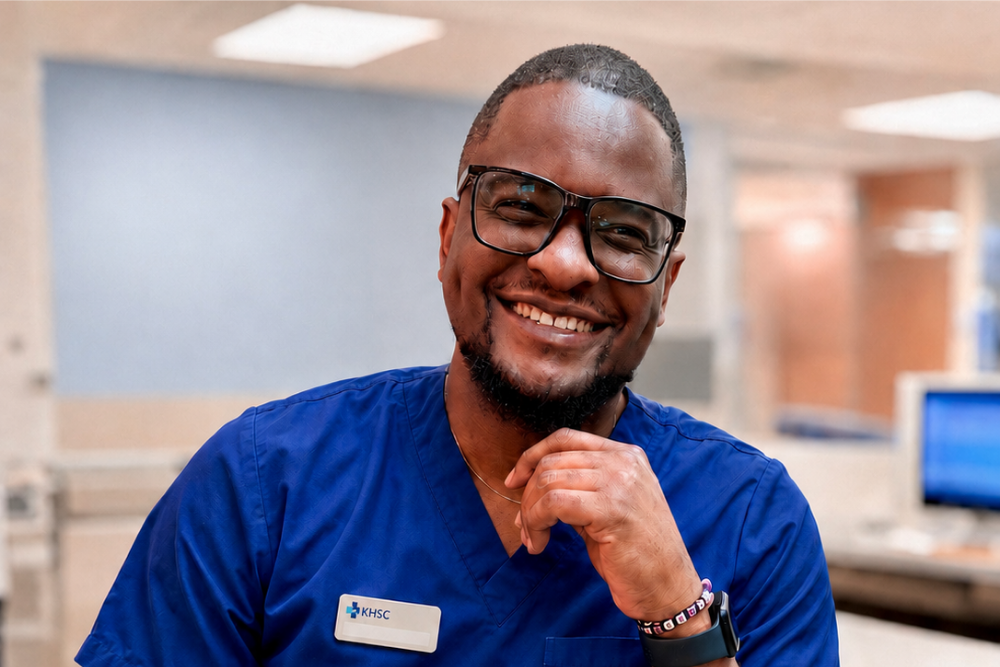
Some career paths begin with a job search. Others begin with a deeply personal experience that changes how we see the world.
For Blessing, the inspiration to pursue a career as a PSW came from a place of love, loss, and reflection. After helping care for his mother through serious health challenges, he discovered a calling that would eventually lead him from a decade-long career in customer service into healthcare.
Today, Blessing works in the neurosciences unit at Kingston Health Sciences Centre, supporting patients during some of the most vulnerable moments of their lives. His journey reflects the power of compassion, perseverance, and education, and how a desire to help others can grow into a meaningful and rewarding healthcare career.
FROM CUSTOMER SERVICE TO HEALTHCARE
Before entering the PSW program, Blessing spent approximately 10 years working in customer service. While the role taught him valuable skills, he found himself searching for something more meaningful.
“Working in customer service taught me a lot about compassion, communication, problem-solving, and basically how to connect with people from different walks of life. Over time, I realized that I wanted to do work that was more meaningful and people-oriented, and that's what led me to healthcare.”
Looking back, many of the skills he developed during those years would become valuable assets in his healthcare career. The ability to communicate effectively, connect with people, and provide support would later become essential parts of his work as a PSW.
A PERSONAL REASON FOR BECOMING A PSW
The decision to pursue healthcare was influenced by an experience that remains close to Blessing’s heart.
“I've always been someone who naturally enjoys helping and supporting people, so what drew me to becoming a PSW was the opportunity to make a real difference in other people's lives, especially during vulnerable moments when they really need care, comfort, and reassurance the most.”
His motivation became even more personal when reflecting on his mother's health journey.
“I took care of my mom after her struggles with hypertension and after she had a stroke. Unfortunately, she passed away in 2003, but this opportunity gave me a chance to give back in a way I couldn't at that time. I always say, if I knew then what I know now after doing the PSW program, I probably would have helped her better during her last days.”
That experience continues to shape the way he approaches patient care today.
FINDING THE RIGHT PATH THROUGH ANDERSON COLLEGE
Blessing first discovered Anderson College through the Ontario government's PSW initiative and quickly found that the program aligned with what he was looking for.
“It turned out to be an amazing fit for me because I realized Anderson has a strong reputation. The way the program combined theory with practical learning, especially during those Covid days, was really good. We still got hands-on training during the lab practices. The North York campus specifically was convenient for me because I lived in Etobicoke at the time, and I felt it offered the kind of structured learning environment that I really needed to succeed.”
His experience reflects how a strong PSW training program can help students build both confidence and practical skills, even during challenging circumstances.
LEARNING THROUGH CHALLENGE AND SUPPORT
Like many students entering healthcare for the first time, Blessing found the program demanding, but also deeply rewarding.
“My experience in the program was both challenging and rewarding. It was definitely fast-paced, but it pushed me to grow both academically and personally. I left the program feeling more confident and prepared for the healthcare field. As someone who had not been in healthcare before, I really felt prepared and confident to handle whatever challenges I might face.”
One of the aspects he appreciated most was the supportive learning environment.
“What stood out the most was how supportive the learning environment was. The combination of virtual classroom learning, lab practices, and the placement experience really helped me connect everything together and made the transition into healthcare feel more realistic for me.”
Blessing also credits the support of his instructors and academic team for helping him succeed throughout the program.
“They were very supportive throughout my learning experience. They were patient, knowledgeable, and always encouraged us to ask questions and stay engaged with the course material.”
BUILDING CONFIDENCE THROUGH PLACEMENT
For Blessing, placement was where everything began to come together.
“I feel the program prepared me really well. It gave me both the technical skills and the confidence that I needed to work in those environments. The placement especially helped me understand what the day-to-day realities of the job look like.”
He completed his placement at Village of Humber Heights in Etobicoke, where he gained valuable firsthand experience working directly with residents and healthcare teams.
The experience also reinforced many of the core skills he continues to use every day.
“For me, the most important skills have been communication, infection control, proper documentation, patient safety, and time management. All of these have been very useful in my daily work. Beyond that, learning the importance of empathy, dignity, and person-centered care has stayed with me.”
These foundational skills continue to support him throughout his personal support worker career.
FROM PLACEMENT TO PROFESSIONAL PRACTICE
After completing his placement, Blessing's healthcare career began to gain momentum.
“After I finished my placement at the Village of Humber Heights, they offered me a casual position soon afterward, which I was willing to take at the time because I didn't have any other opportunities.”
He also received support from Anderson College's Career Services team as he prepared for the next step in his career.
“I worked with Amanda from the Careers department at Anderson College. She helped me build my resume and went through the process step-by-step with me. She helped me create a very strong resume, which I sent out, and I eventually got a full-time position at Arbour Heights in Kingston.”
The opportunity led to a major life change.
“I finished my placement on March 31, 2023, and then I started at Arbour Heights in Kingston in May that same year. It was great because I had already been offered a position by the Village of Humber Heights where I had done my placement, but this was a more lucrative opportunity and it was full-time, so I jumped on it. That's when I moved from Toronto to Kingston.”
For Blessing, this marked the beginning of a successful healthcare career change and a new chapter of professional growth.
GROWING THROUGH EVERY HEALTHCARE SETTING
Over the years, Blessing has gained experience across multiple healthcare environments, each providing new opportunities to learn and grow.
“The most rewarding part has been seeing my own growth. Coming from a different professional background, stepping into healthcare, and now being able to contribute meaningfully in a hospital setting has been incredibly rewarding.”
He spent a year working in long-term care before transitioning into the hospital environment where he works today.
“The transition from a retirement home to long-term care, and now to a hospital setting, where I've been for the past two years at Kingston Health Sciences Centre, has been a very meaningful journey for me.”
Moving into the hospital setting introduced new learning opportunities and exposure to larger interdisciplinary healthcare teams.
“I find the hospital setting much lighter than long-term care and more rewarding because there are a lot of people to learn from, and you're not dealing with the same patients throughout your experience. People come and go, but it's really a very good learning environment.”
SUPPORTING PATIENTS AT KINGSTON HEALTH SCIENCES CENTRE
Today, Blessing works in the neurosciences unit at Kingston Health Sciences Centre, where collaboration and patient-centered care are central to his role.
“In my current role, I basically support patients with their daily care needs. I assist with mobility, provide comfort measures, and work very closely with the nurses and the broader healthcare team to ensure patients are receiving quality care.”
He values the opportunity to work alongside a wide range of healthcare professionals.
“As you know, in a hospital setting there are many healthcare teams involved, from physiotherapy to security, nursing teams, and doctors.”
One of the aspects he enjoys most is that every day presents something different.
“I'll be honest, no two days are exactly the same, which is one of the things I enjoy about the role. A typical shift involves assisting patients with personal care, mobility, monitoring needs, documentation, and responding to whatever support patients may need throughout the day.”
MAKING A DIFFERENCE DURING VULNERABLE MOMENTS
At the heart of Blessing's work is the desire to help people feel supported, comfortable, and respected.
“Like I said earlier, when my mom was sick, I always wished I had known the things that I know now. One of the most rewarding parts of this role is seeing how much of a difference your work can make. Sometimes simply helping a patient feel comfortable, heard, or supported can have a meaningful impact on their day.”
He also recognizes the importance of supporting families during difficult moments.
“I believe I make an impact by helping patients maintain dignity, comfort, and a sense of support, especially during difficult or vulnerable moments. Being able to provide reassurance to both patients and their families is something that I value deeply.”
ADVICE FOR FUTURE PSWS
For students considering a PSW program in Ontario or currently completing their studies, Blessing offers simple but meaningful advice.
“I'll keep this simple. Stay committed and trust the process. I won't lie, the program can be demanding, but it's totally worth it.
“My advice would also be to ask questions, stay open to learning, and make the most of your placements because that's where a lot of your growth happens.”
A JOURNEY BUILT ON COMPASSION AND PURPOSE
Blessing's story is a powerful reminder that meaningful careers are often built from life's most personal experiences.
What began as a desire to help others and honour the memory of his mother became a rewarding journey through Anderson College's PSW program and into a successful healthcare career. Along the way, he gained the knowledge, confidence, and hands-on experience needed to thrive in long-term care and hospital settings while making a meaningful difference in the lives of patients and families.
Today, as a healthcare professional at Kingston Health Sciences Centre, Blessing continues to bring compassion, dignity, and support to those who need it most. His journey stands as a powerful PSW success story, showing what is possible when dedication, empathy, and purpose come together in service of others.
READY TO EXPLORE A CAREER AS A PSW?
Blessing's journey demonstrates how the right education, hands-on training, and commitment to helping others can lead to rewarding personal support worker jobs and long-term career growth.
Explore our Personal Support Worker program today
Book a virtual appointment with an admissions advisor.
Take our Personal Support Worker Career Discovery Quiz and discover whether a career in healthcare is right for you.
Found this useful? Share it with a friend who's exploring their next career step.
Frequently asked questions
Quick answers about applying, funding, and life at Anderson College.
What does a personal support worker (PSW) do?
How do I become a personal support worker in Ontario?
Is personal support worker a good career in Ontario?
Can I switch careers and become a PSW later in life?
What skills do you learn in a PSW program?
Does a PSW program include hands-on training?
What skills from customer service helped Blessing in healthcare?
How long does it take to complete a program at Anderson College?
What financial aid options are available?
Are international students welcome?
How do I apply?
Does Anderson College offer job placement support?
Still have a question? Speak with an Admissions Advisor →
More from the blog

How OHS Professionals Reduce Workplace Accidents
How OHS professionals reduce workplace accidents through hazard prevention, safety training, risk management, and workplace safety leadership.…
Read article
From Job Search Struggles to an MLPAO Bursary: Amanda's Medical Lab Journey
After three degrees and over a year of job searching, Amanda found her calling in medical laboratory assistant training and won an MLPAO bursary.…
Read article
How Supply Chains Keep the World Running
Discover how supply chains keep the world running, why demand for supply chain professionals is growing, and where a career in logistics can lead.…
Read article